Building Cost-Effective Blockchain Infrastructure: A Journey with eRPC and Ponder
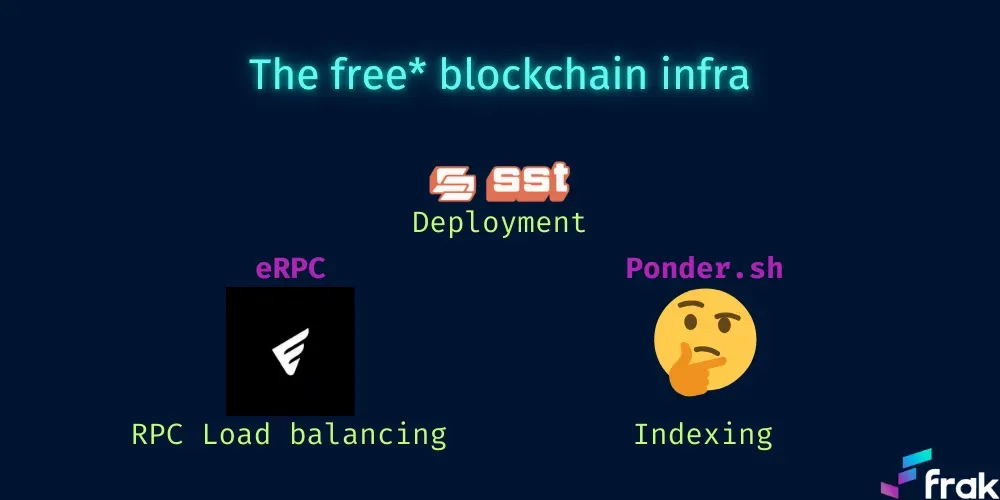
Every blockchain project starts with a dream and a limited budget. At Frak, we built a platform for automated on-chain reward distribution that powers marketing campaigns through smart contracts. Running entirely on Arbitrum, our infrastructure needs to handle:
- High-frequency events: Processing ~8 user tx per week per active user
- Complex queries: Real-time analytics and reward calculations
- Multi-contract indexing: 8 master contracts and 3 active factories (with, at the time of writing, ~100 contracts deployed).
When your core business logic lives on-chain, your infrastructure needs to be bulletproof while keeping costs under control. Here’s how we built it using open-source tools.
The Challenge
Every blockchain application faces three core challenges:
- Reliable and cost-effective RPC access
- Efficient event indexing and data access
- Scalable infrastructure that doesn’t break the bank
Most teams throw money at the problem. We took a different approach.
eRPC: Your Chain’s Traffic Controller
eRPC is like the air traffic controller for your blockchain requests: but one that also has a photographic memory and cost-optimization superpowers. Written in Go for maximum performance, it’s a fault-tolerant EVM RPC load balancer that makes your typical proxy look like a rusty gate.
Key Features That Made Us Choose eRPC
Intelligent Load Balancing
- Per-method routing (because let’s face it, not all RPCs are created equal)
- Project-specific configurations (different strokes for different folks)
- Automatic fallback handling (because uptime is not just a nice-to-have)
Smart Caching
- Reorg-aware permanent caching (no more stale data nightmares)
- Method-specific cache rules (cache what matters, ignore what doesn’t)
- Selector-level granularity (because sometimes you only need to cache specific contract calls)
Developer Experience Superpowers
- Need to scale your dev team? Got smart contract tests hitting your RPC like a MEV bot during an airdrop? eRPC’s project system lets you:
- Create dedicated environments for different teams
- Implement IP-based or wallet signature auth
- Configure aggressive caching for test environments
- Zero config changes for developers (it just works™)
Power in Simplicity
Want to see how easy it is to do complex things? Here’s an eRPC config that handles multi-provider load balancing, rate limiting, method-specific routing and caching:
export default initErpcConfig({
    logLevel: "info",
    database: {
        // Here you can list every db used (pg, redis, in memory etc), and then config which one are used depending on the type of data, or even the method used
        // Frak config here: https://github.com/frak-id/infra-blockchain/blob/6e907c50db2117083a113ee74e2d38d1a6b596ea/packages/erpc/src/storage.ts
        evmJsonRpcCache: cacheConfig,
    },
})
    .addRateLimiters({
        // Yup, you can even go in depth with per method rate limiting
        alchemy: [{ method: "*", maxCount: 300, period: "1s", waitTime: "5s" }],
        pimlico: [{ method: "*", maxCount: 100, period: "1s", waitTime: "5s" }],
        drpc: [{ method: "*", maxCount: 100, period: "1s", waitTime: "5s" }],
        // And yup, rate limits can also be applied to networks, auth strategies, projects, etc
        walletProject: [{ method: "*", maxCount: 1000, period: "1s", waitTime: "5s" }],
    })
    // Add a few networks to the config
    .decorate("networks", {
        arbitrum: arbNetwork,
        arbitrumSepolia: arbSepoliaNetwork,
    })
    // Add a few upstreams to the config
    // Frak upstreams config: https://github.com/frak-id/infra-blockchain/blob/main/packages/erpc/src/upstreams.ts
    .decorate("upstreams", {
        alchemy: alchemyUpstream,
        drpc: drpcUpstream,
        pimlico: pimlicoUpstream,
    })
    .addProject(({ store: { upstreams, networks } }) => ({
        id: "wallet-rpc",
        // Smart routing: Pimlico for AA, Alchemy for everything else, dRPC as fallback
        upstreams: [            upstreams.alchemy,
            upstreams.pimlico,
            upstreams.drpc
        ],
        networks: [networks.arbitrum, networks.arbitrumSepolia],
        // Rate limiting with the budget defined before
        rateLimitBudget: "walletProject"
    }))
    .build();
In this example we are using the erpc-config-generator package that provide the builder pattern, you can also directly use the erpc typescript config.
Our Production Setup
And here’s how eRPC makes blockchain load balancing and multi-RPC routing look easy and helps us achieve virtually no downtime:
Indexing Projects
- Primary: Envio + dRPC
- Fallback: Alchemy
- Why? Cost optimization for high-volume historical queries
General Purpose (Frontend + Backend + Foundry)
- Primary: Alchemy + Pimlico
- Fallback: dRPC
- Auxiliary: Free RPCs for non-critical paths
Ponder: The Indexer That Sparks Joy
If you’ve ever wrestled with The Graph’s hosting service, Ponder feels like a warm hug from your favorite dev tool. It’s the indexer that makes you remember why you loved blockchain development in the first place.
// Track when a campaign distribute a reward
ponder.on("CampaignBanks:RewardAdded", async ({ event, context }) => {
    // Try to find a rewarding contract for the given event emitter
    const bankingContract = await context.db.find(bankingContractTable, {
        id: event.log.address,
    });
    if (!bankingContract) {
        console.error(`Banking contract not found: ${event.log.address}`);
        return;
    }
    // Update the total amount of distributed token for the rewarding contract
    await context.db
        .update(bankingContractTable, {
            id: event.log.address,
        })
        .set({
            totalDistributed:
                bankingContract.totalDistributed + event.args.amount,
        });
    // Update the current user reward (insert it if not found)
    await context.db
        .insert(rewardTable)
        .values({
            contractId: bankingContract.id,
            user: event.args.user,
            pendingAmount: event.args.amount,
            totalReceived: event.args.amount,
            totalClaimed: 0n,
        })
        .onConflictDoUpdate((current) => ({
            pendingAmount: current.pendingAmount + event.args.amount,
            totalReceived: current.totalReceived + event.args.amount,
        }));
    // Insert the reward event
    await context.db.insert(rewardAddedEventTable).values({
        id: event.log.id,
        contractId: bankingContract.id,
        user: event.args.user,
        emitter: event.args.emitter,
        amount: event.args.amount,
        txHash: event.log.transactionHash,
        timestamp: event.block.timestamp,
    });
    // Update the current campaigns stats for the distributed amount
    await safeIncreaseCampaignsStats({
        productId: bankingContract.productId,
        context,
        blockNumber: event.block.number,
        increments: {
            totalRewards: event.args.amount,
        },
    });
});
Real-World Indexing at Frak
We’re not talking about toy contracts here. We’re indexing:
- 8 master contracts
- 3 active factory contracts
- On Arbitrum (hello, short block times 👋)
- Complex marketing campaign tracking
- Real-time statistics generation
Why Ponder Won Our Hearts
Blazing Fast Indexing
- Reindexing that doesn’t require a coffee break
- Internal caching that makes updates feel instant
- Direct PostgreSQL integration that just works
Real-world Performance
- Handles complex on-chain marketing campaigns
- Real-time statistics generation
- Shared database with Web2 backend (bye-bye, unnecessary data transfer)
Developer Experience That Doesn’t Suck
- TypeScript all the way down
- Built-in HTTP server via Hono
- Caching and rate limiting included
Deployment: Because YOLOing to Production is So 2017
SST v3 orchestrates our entire deployment with the elegance of a perfectly executed flash loan:
Infrastructure as Code Benefits
- Zero-touch deployments
- Version-controlled infrastructure
- Easy environment replication
- Pulumi under the hood (because when we eventually move to k8s, we won’t need therapy)
Open Source All The Way Down
Every tool in our stack is open source and actively maintained:
- eRPC: The RPC infrastructure that scales with you
- Ponder: The indexer that just makes sense
- SST: Infrastructure as code that doesn’t make you cry
Want to see how it all fits together? Check out our blockchain infrastructure repo for the complete picture.
Bootstrap Like a Chad, Spend Like a Bear Market
Here’s the secret sauce for launching your blockchain infrastructure without needing a Series A: smart use of free tiers and efficient architecture. Think of it as yield farming cloud credits and RPC calls.
The Zero-to-One Infrastructure Stack
Cloud Foundation 🌩️
- AWS Free Tier = 12 months of free t2.micro instances
- GCP = $300 initial credits
- Choose your poison, both work great with our stack
RPC Strategy 🔌
.addProject({
  id: "bootstrap-rpc",
  upstreams: [    // Free RPCs, strategically load balanced
    llamaNodes,     // 25k requests/day
    publicNodes,    // Variable limits
    ankr.free,      // 20k requests/day
    // Add more as you grow
  ]
})
Indexing & API 📊
- Self-hosted Ponder = $0 (runs on your free tier instance)
- PostgreSQL = Free tier on cloud provider
- Hono endpoints = Comes free with Ponder
Cost Breakdown for MVP
- Infrastructure: $0 (cloud credits)
- RPC Calls: $0 (load balanced free tiers)
- Indexing: $0 (self-hosted)
- Your time: Minimal (thanks to these tools)
When You’re Ready to Scale 📈
Hit the free tier limits? Congratulations, you’ve got traction! When it’s time to graduate from farming free RPCs, check out eRPC’s aggregator service. It’s one unified endpoint for all chains with pre-negotiated provider rates. They’ll even host the eRPC instance for you if infrastructure management isn’t your thing.
The Results
This setup has allowed us to:
- Start lean (your VCs will thank you)
- Scale smoothly as user base grew
- Maintain high reliability
- Keep infrastructure complexity manageable
- Process complex on-chain marketing campaigns in real-time
What’s Next?
While our current setup is solid, we’re exploring:
- Kubernetes migration for more deployment flexibility
- On-premise solutions for cost optimization
- Further RPC usage pattern optimization
Conclusion
Building blockchain infrastructure doesn’t have to feel like solving a Rubik’s cube blindfolded. With open-source tools like eRPC, Ponder, and SST, you can build a robust, scalable system that grows with your needs.
At Frak, this infrastructure powers a platform that’s revolutionizing brand advocacy:
- Real-time reward distribution for authentic shares
- Transparent, cost-effective customer acquisition
- Direct value flow from brands to advocates
- Scalable word-of-mouth marketing automation
The best infrastructure is like a good smart contract: it just works, and you only notice it when something goes wrong. And when 87% of people read reviews before purchasing and 79% trust customer reviews like friends’ recommendations, you really can’t afford for things to go wrong.